You designed a beautiful living room. The client loved it. You posted it on Instagram.
Then nothing happened.
No new inquiries. No new clients. Just silence.
This is the most common problem interior designers face — great work, zero visibility. You are not bad at your job. You are just invisible. And in 2026, invisible means out of business.
Here are practical ways to fix that.
Why Most Interior Designers Struggle to Get Clients.
Most designers rely on word-of-mouth alone. That works — until it stops.
The problem is that clients today search online before they call anyone. If your work is not showing up where they look, someone else gets the call. Someone who maybe designs worse than you, but shows up better.
The gap is not talent. It is marketing.
Top 10 Tips to Market Your Interior Design Business.
1. Build a Portfolio That Does the Selling for You.

A strong portfolio is the first step to getting more interior design clients
Your portfolio is your first sales pitch. It runs 24/7, even when you are asleep.
Most designers upload blurry phone photos and call it done. That is a mistake. A client looking at bad photos assumes you do bad work — even if you don’t.
Invest in professional photography for every major project. Clean, well-lit, high-resolution images tell the client exactly what they are getting. If you need quality commercial photography for your portfolio or brand assets, that alone separates you from 80% of your competition.
2. Show Your Space in 3D — Before the Client Even Visits.
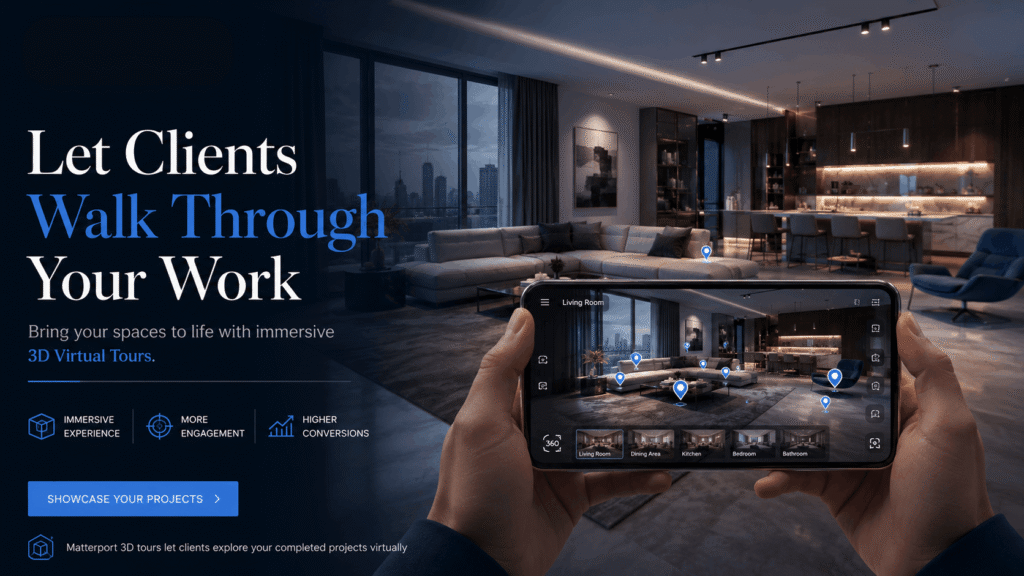
Matterport 3D tours let clients explore your completed projects virtually
Imagine a client can walk through your past project from their phone. They open a link, look around the room in every direction, check the ceiling, the flooring, the light — all before meeting you.
That is not a fantasy. It is a Matterport 3D Tour.
Interior designers who use 3D walkthroughs on their portfolio sites get longer time-on-page and more inquiries. Because the client feels they already know your work — and trust builds fast when people can see clearly.
A 360-degree virtual tour of a completed project can live on your website permanently. One shoot. Infinite impressions.
3. Use Drone Shots to Make Projects Look Bigger.
Most designers shoot interiors from eye level. That is fine, but it is also exactly what everyone else does.
Drone photography gives you overhead and wide-angle shots that show the full scale of your project — whether it is a villa, a retail outlet, or a large apartment complex. It makes everything look bigger and more impressive.
Real estate developers and premium clients respond to this. They want to see scope, not just styling.
One drone shoot on a completed project can become your most-shared content on Instagram or LinkedIn. It is unexpected. It stops the scroll.
4. Get Listed on Google with a Street View Tour.
When someone types “interior designer near me” on Google, what shows up?
Businesses with Google profiles that have photos and a verified street view listing rank higher and get more clicks. It is that simple.
A Google Street View tour for your studio or showroom puts you on Google Maps with an interactive walkthrough. Clients can see your physical space before visiting. That builds trust immediately.
If you do not have this set up, you are leaving free traffic — and free clients — on the table every single day.
5. Create Short Videos That Show Your Design Process.
Nobody wants to read a long explanation of your design philosophy. But they will watch a 60-second video showing a space transform from empty to finished.
Short-form videography is the single fastest way to build trust with a cold audience. A before-and-after reel. A behind-the-scenes look at your moodboard session. A quick site visit turned into a story.
Post these on Instagram Reels, YouTube Shorts, and LinkedIn. Clients who watch your videos before calling you are already half-sold.
If you want to go further, a corporate video production shoot for your brand can serve as evergreen content for your website and ad campaigns for years.
6. Use Real Estate Photography to Win Developer Clients.
One developer client equals five to ten regular residential clients. Maybe more.
Developers need interiors photographed for brochures, websites, portals, and handover documents. If you position yourself as someone who can design AND hand them shoot-ready spaces, you become irreplaceable.
High-quality real estate photography of your completed projects — shot professionally, not on your phone — is what gets you in front of developer clients. Send them a link. Let the visuals speak.
This is a market most interior designers ignore. You should not.
7. Run Targeted Social Media Ads.
Organic reach on social media is shrinking every year. That is just the reality.
Paid ads let you put your portfolio in front of exactly the right person — homeowners in a specific city, newly married couples, developers in your area — for a few hundred rupees a day.
The key is your creative. Bad visuals equal wasted money. Strong visuals from a proper commercial shoot make your ads stop people mid-scroll.
Start small. Test two or three images. Double down on what works.
8. Ask for Referrals the Right Way.
Happy clients do not automatically refer people. You have to ask — and make it easy.
After a project closes, send a short message. Tell them who your ideal next client is. Ask if they know anyone buying or renovating. Offer a small referral thank-you.
Most designers feel awkward doing this. But a referral from a satisfied client is warmer than any ad you will ever run.
Do this once per month with past clients. It costs nothing and consistently brings in work.
9. Collaborate With Real Estate Agents and Developers.
Real estate agents and developers are always working with people who just bought a space and need it designed. They are a steady pipeline.
Meet two or three agents in your city. Offer to style a property for a listing shoot — even at a discount — so they see your work. Once they trust you, they send clients your way regularly.
Pair this with a proper real estate photography package and you become a full-service partner — not just a designer.
That partnership is where stable, recurring revenue comes from.
10. Keep Showing Up Online — Consistently.
This is the one that most people skip.
They post for two weeks, get no immediate results, and stop. Then six months later they wonder why their pipeline dried up.
Consistency compounds. A client who saw your Reel in January, your blog in March, and your project on LinkedIn in May will call you in June — because you stayed visible.
Pick two platforms. Post three times a week. Show your process, your projects, your thinking. You do not need to go viral. You just need to not disappear.
Want More Premium Clients?
Let’s Build Your Digital Presence – Contact Now