


By the Cinematic 360 Editorial Team · Mumbai, India
Vikram had been sitting on his decision for four months.
A ₹3.8 crore apartment in Powai — great views, good project, trustworthy developer. He had visited twice. He had the floor plan saved on his phone. He was, in the language of real estate sales teams, a warm lead.
The developer’s marketing team had called twice in August. Twice in September. No response.
Then in the first week of November, the developer released a 90-second aerial film of the project. The Mumbai skyline at dusk, Powai lake shimmering, warm festive light. Vikram watched it on Instagram on a Friday evening.
He called Monday morning. Booked by Wednesday.
The apartment had not changed. The price had not changed. The view had not changed.
The timing had.
” The product was identical in August and November. The buyer was not. “
Why Does December Outperform January in Mumbai Real Estate Marketing?
December generates more qualified buyer activity in Mumbai real estate than January because it falls within India’s peak festive-to-year-end buying window (October–December), when buyer psychology is spending-positive, aspirational, and emotionally primed for major purchases. Buyers who have been considering a property through the year are more likely to decide in Q4, driven by Diwali sentiment, year-end tax and investment planning, and the cultural association of new beginnings at the festive cycle’s close. January, by contrast, sees buyers recovering from festive spending and recalibrating priorities — a psychologically cooler month for emotional purchase decisions.
Mumbai’s Real Estate Market Has a Hidden Calendar
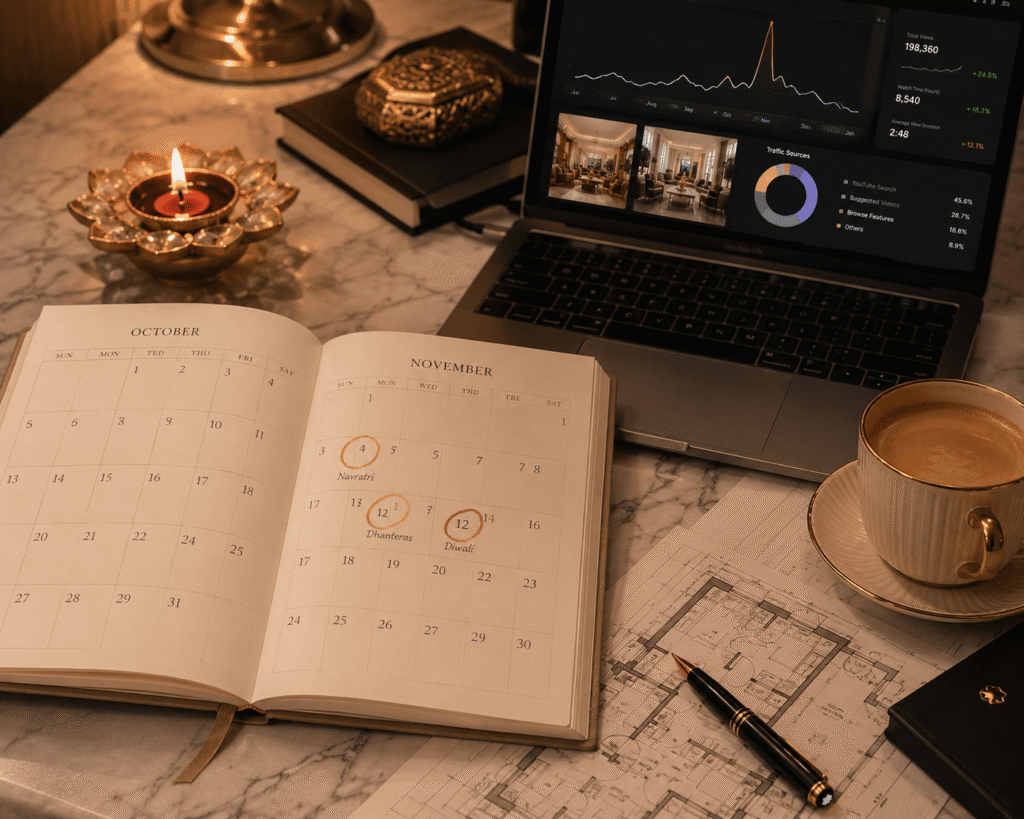
Luxury Property Search Experience on Mobile
Ask most Mumbai developers when they run their biggest campaigns and they will tell you: March–April and October–November. The standard festive push around Navratri and Diwali, and the end-of-financial-year surge in spring.
Ask the data a different question — when are buyers most emotionally ready to make a final decision — and the answer is more nuanced.
November and December, it turns out, punch above their weight in a way that few builders’ marketing calendars fully exploit.
The Psychology of the Festive-to-Year-End Window
The Indian festive season is not just a cultural event. It is a psychological state.
From mid-October through December, Indian consumers — and particularly the HNI segment that drives Mumbai’s luxury market — are in an extended period of celebratory, forward-looking, spending-positive mental mode. Diwali, the most significant home-purchase occasion in India’s cultural calendar, sets the emotional tone. New homes. New beginnings. Prosperity.
But the effect does not end when the diyas are put away.
November and December inherit the Diwali sentiment. Buyers who did not commit during Diwali week are often still in the decision zone — slightly more deliberate now, but still emotionally open. Combined with year-end bonus distributions, tax planning season, and the cultural impulse toward closure before the new year, this creates a remarkably fertile 6–8 week window that many developers abandon too early.
Why January Underperforms (and Most Developers Don’t Realise It)

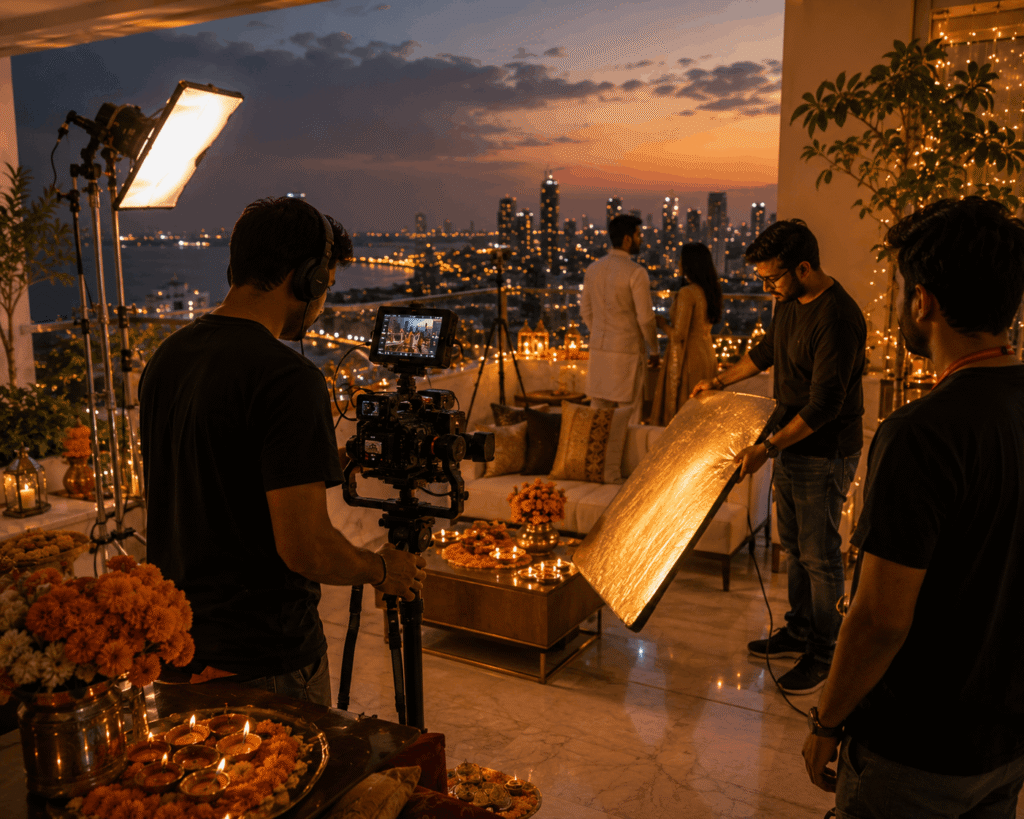
A professional production crew filming luxury real estate content on a festive Mumbai terrace during Diwali week
January carries the feeling of fresh starts — but in practice, it is a psychologically cooler month for high-stakes purchase decisions.
Festive spending has happened. Budgets have been reviewed. The emotional high of Diwali and Christmas has passed. Buyers who were warm in November are now in recalibration mode, especially NRI visitors who return to their overseas base after the festive visits.
This does not mean January is dead — Q1 has its own logic, particularly for investment buyers responding to budget season and the financial year end. But the emotional warmth that drives luxury residential decisions is quantifiably lower in January than in the preceding two months.
Property portals like 99acres and Housing.com have noted higher browse-to-inquiry conversion rates in October–December compared to January–February. The festive window is not just more active — it is more decisive.
What This Means for Real Estate Video and Visual Content
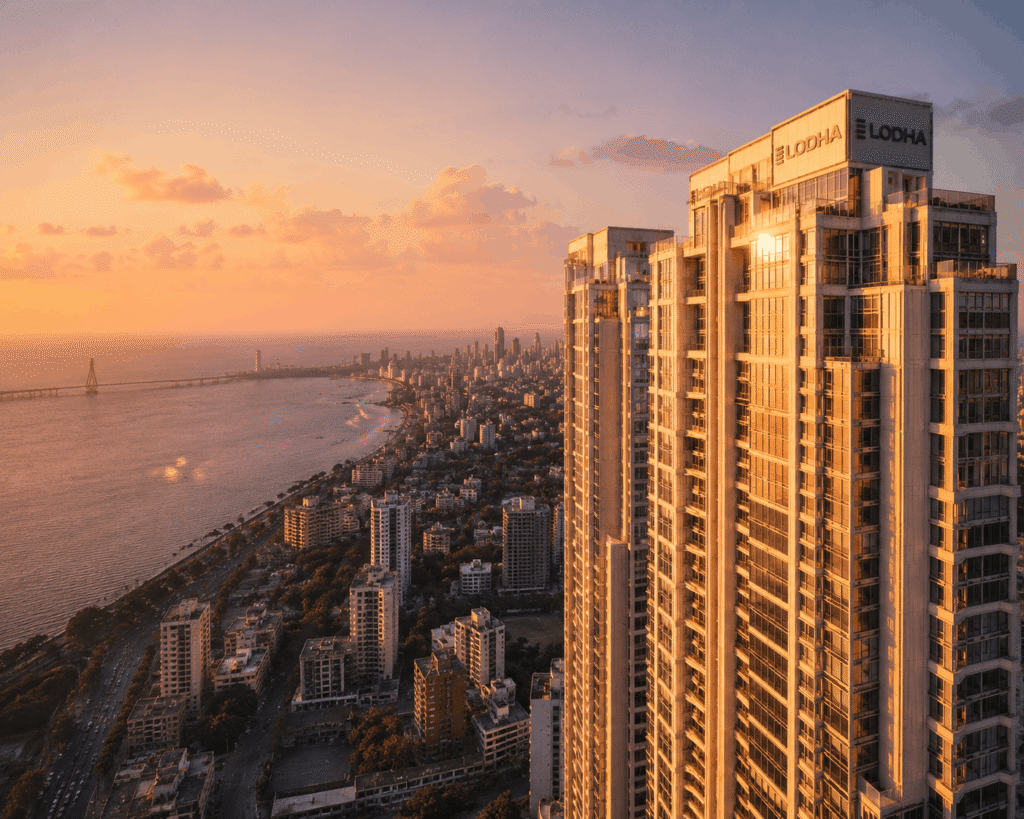
Aerial drone photograph of a luxury Mumbai residential tower glowing in November’s warm golden-hour light.
Here is where the strategic insight becomes actionable.
A real estate video released in the first week of November reaches a buyer who is already emotionally primed. The same video released on January 15th reaches a buyer who is deciding whether to make a budget for Q1, not whether to book this weekend.
The content does not need to be different. The timing makes it land differently.
The Festive Visual Content Advantage
Elegant Indian couple in festive attire viewing luxury property content on a tablet in a warmly lit living room during Diwali.
Beyond timing, the festive season creates a genuine visual opportunity that smart developers use.
November and December light in Mumbai is extraordinary. The post-monsoon air is clean, the golden hour is long, the city looks its best. Properties photographed and filmed in November have a natural warmth and clarity that June or September cannot replicate.
This is not a minor point. Real estate photography and videography captured during the festive window carries an atmospheric quality that viewers feel, even if they cannot name it. The warmth of November light communicates home. Safety. Belonging.
Developers who invest in professional aerial drone videography, brand films, and interior photography sessions timed for November are not just getting better content for the festive campaign — they are building a visual asset library with the warmth and quality that will serve every campaign for the next 12–18 months.
The Mumbai Real Estate Seasonal Marketing Calendar
Based on buyer behaviour patterns in Mumbai’s luxury and premium residential segment, here is a strategic framework for aligning visual content and campaign spending with peak buyer windows:
The Critical Planning Insight: Start 90 Days Before the Window
The developers who win the October–December window do not start planning in October.
They commission their drone videography in August. They plan their brand film shoot for September. They begin their digital pre-campaign — teaser content, audience building, remarketing lists — in October, weeks before the Diwali campaign officially launches.
By the time their competitors are placing newspaper ads in late October, these developers already have a warm audience of 50,000 qualified digital users who have been seeing their content for six weeks.
The festive campaign is the closing act of a story that started months earlier. The developers who treat it as the beginning of the story are always playing catch-up.
Real Estate Launch Campaign Ideas for the Festive Window
▸ The Diwali Preview Release — A photorealistic 3D render or property film dropped on Dhanteras or Diwali eve — when buyers are at maximum emotional readiness and actively checking their phones
▸ The ‘November Light’ Photography Series — Commissioning professional interior and architectural photography during November specifically to capture the unique quality of post-monsoon festive-season light
▸ The NRI Return Campaign — Targeted digital content (brand films, Matterport tours, drone footage) released in late October, timed to reach NRI buyers before and during their festive India trips
▸ The Year-End Decision Nurture — A November–December email and social sequence for warm leads who visited but did not book — using seasonal content to reactivate emotional desire
▸ The ‘New Year, New Home’ Bridge — Content strategy that extends the festive window through late December, positioning the new year as a natural moment to commit to a new property
The Contrarian Argument: Don’t Abandon the Off-Season
Here is where most seasonal marketing guides stop — and where this one goes further.
The festive window is the conversion season. But the off-season is the brand-building season.
The buyers who book in November have typically been watching a developer’s content since May. The Matterport tour they explored in July. The Instagram reel they saw in August. The brand film they saved and watched again in September.
The festive campaign harvests what the off-season planted.
Developers who cut their visual content budgets between January and September, then wonder why their Diwali campaign underperforms, have misunderstood the funnel. The festive buyer is not a new buyer. They are a nurtured buyer who has finally reached emotional readiness.
” The best Diwali campaigns were built in June. The best January launches were planned in August. “
What This Means for Your 2025–26 Marketing Calendar
Whether you are a developer planning your next Mumbai launch, a builder with unsold inventory, or an interior designer building a portfolio for new client acquisition — the seasonal insight is the same:
Align your visual content production with the buyer calendar, not the project calendar.
▸ Commission drone footage and brand films in September–October — for festive season deployment
▸ Build your digital pre-campaign audience in August–September — before the festive window opens
▸ Use the off-season (April–August) for SEO content, Matterport tours, and 3D visualization — — content that nurtures buyers through a long consideration phase
▸ Treat November and December as your highest-ROI marketing months — and budget accordingly
▸ Plan January–March for NRI conversion and investment buyer messaging — with the residual festive warmth still present in the market
The homes do not know what month it is. The buyers do.
The developers who understand this — and build their real estate marketing strategy in Mumbai around the buyer’s calendar rather than the project’s calendar — consistently outperform those who don’t.- Call Now
Q1. What is the best time to market real estate projects in Mumbai?
The best time to market real estate projects in Mumbai is the October–December festive-to-year-end window, followed by February–March (pre-financial-year-end). October–December benefits from Diwali buyer sentiment, NRI festive visits, year-end bonus distributions, and a cultural predisposition toward major life decisions before the new year. Campaigns launched in this window consistently achieve higher inquiry rates, faster conversion, and stronger pricing outcomes than equivalent campaigns in other periods.
Q2. Why does real estate marketing perform better in December than January in Mumbai?
December sits at the tail of India’s festive buying cycle, when buyers who have been considering a property through Navratri and Diwali are still emotionally primed but now more deliberate in their decision-making. January sees post-festive budget recalibration and the return of NRI visitors to overseas bases, reducing both the emotional warmth and the physical presence of high-intent buyers. December is a closing month; January is a restarting month.
Q3. What is seasonal real estate marketing and why does it matter?
Seasonal real estate marketing is the practice of aligning campaign timing, content type, and budget allocation with cyclical patterns in buyer psychology and purchasing behaviour. In Mumbai, these cycles are driven by the Indian festive calendar (Navratri, Diwali), the financial year (April–March), NRI travel patterns, monsoon seasonality, and school admission calendars. Developers who align their visual content production and campaign spending with peak buyer-intent windows consistently achieve better ROI than those following project-driven rather than buyer-driven calendars.
Q4. What real estate launch campaign ideas work best for Mumbai’s festive season?
The most effective festive season real estate launch campaigns in Mumbai include: a property brand film released on Diwali eve (when buyer emotional readiness peaks), a Dhanteras or Dussehra 3D render reveal series on social media, an NRI-targeted digital campaign aligned with festive travel bookings, a Matterport virtual tour activation for non-resident buyers who cannot visit in person, and a November–December ‘warm lead reactivation’ campaign targeting buyers who showed interest but did not commit during the main Diwali push.
Q5. How should Mumbai developers plan their visual content calendar for peak season?
Mumbai developers should plan visual content production 90 days before the peak season window. For the October–December festive season, this means commissioning drone videography and brand film production in August–September, beginning digital audience building in early October, and deploying the full content suite (brand film, 3D renders, Matterport tours, drone footage) as a sequenced release from Navratri through Diwali and into December.
Q6. What property marketing strategies work best for Mumbai builders year-round?
A year-round property marketing strategy for Mumbai builders should treat different seasons as having different objectives: Q4 (Oct–Dec) for conversion campaigns, Q1 (Jan–Mar) for NRI and investment buyer follow-up, Q2 (Apr–Jun) for brand awareness and digital audience building, and Q3 (Jul–Sep) for off-plan content — Matterport tours, 3D visualization, SEO-driven blog content. Visual content production (photography, video, drone) should be scheduled for September–October to capture festive-season light and timing advantages.
Q7. Why does real estate video content perform better during the festive season?
Real estate video content performs better during the festive season for two distinct reasons. First, audience psychological state: buyers are emotionally primed for aspirational decisions, spending more time on their devices consuming premium content. Second, environmental quality: November–December Mumbai light is post-monsoon — cleaner air, warmer golden hour, longer atmospheric quality — which gives professionally shot property films a natural warmth that resonates emotionally with viewers.



Bookmarking this one on “Why December Real Estate Videos Generate More Leads in Mumbai Than January”. While we’re on the subject, SCADA PLC has a solid write-up that pairs well with it.