Most 360° virtual tours look like they were shot on a doorbell camera.
Flat. Low resolution. Zero depth. The viewer feels like they’re looking at a miniature dollhouse – not standing inside a ₹5-crore penthouse.
The problem isn’t the concept of VR. It’s the execution.
Professional Insta360 videography is about much more than putting a 360° camera on a tripod and pressing record.
This guide covers the complete Cinematic360 production workflow for cinema-grade 8K immersive VR – from hardware setup to final client delivery – including lessons from our real production experience at Chhatrapati Shivaji Maharaj Terminus (CSMT), Mumbai
Module 1: Virtual Tour vs. Cinematic 8K VR.
Most 360° tours are shot on consumer cameras at 5.7K. They’re fine for basic walkthroughs.
Cinematic 8K VR is a different product entirely.
Monoscopic (8K 2D at 60fps) – for standard web-based virtual tours and Google Street View integration where flat viewing is the primary use case.
Stereoscopic (8K 3D at 30fps) – for Meta Quest 3, Quest Pro, and Apple Vision Pro headset deployment where true human depth perception and spatial scale are essential.
This is what makes a luxury penthouse, showroom, or architectural space actually feel like a real environment rather than a flat video.
The 1-Meter Safe Distance Rule
Every subject, wall, and furniture piece must stay at least 1 meter from any lens. Closer than that, and the optical intersection between lenses can create ghosting and stitch errors that become difficult to correct in post.
REAL EXPERIENCE – CSMT Mumbai
During our CSMT production, the architecture itself became an important part of the 360° composition.
The location had large arches, detailed ceilings, columns, staircases, and open architectural sections. Unlike a conventional camera, where the operator can simply choose what stays outside the frame, the Insta360 Pro 2 captures the complete environment around the camera.
That meant we had to plan our camera position carefully. The camera wasn’t simply placed where it was convenient; we had to consider the architecture, movement, crew position, and the final 360° viewing experience.
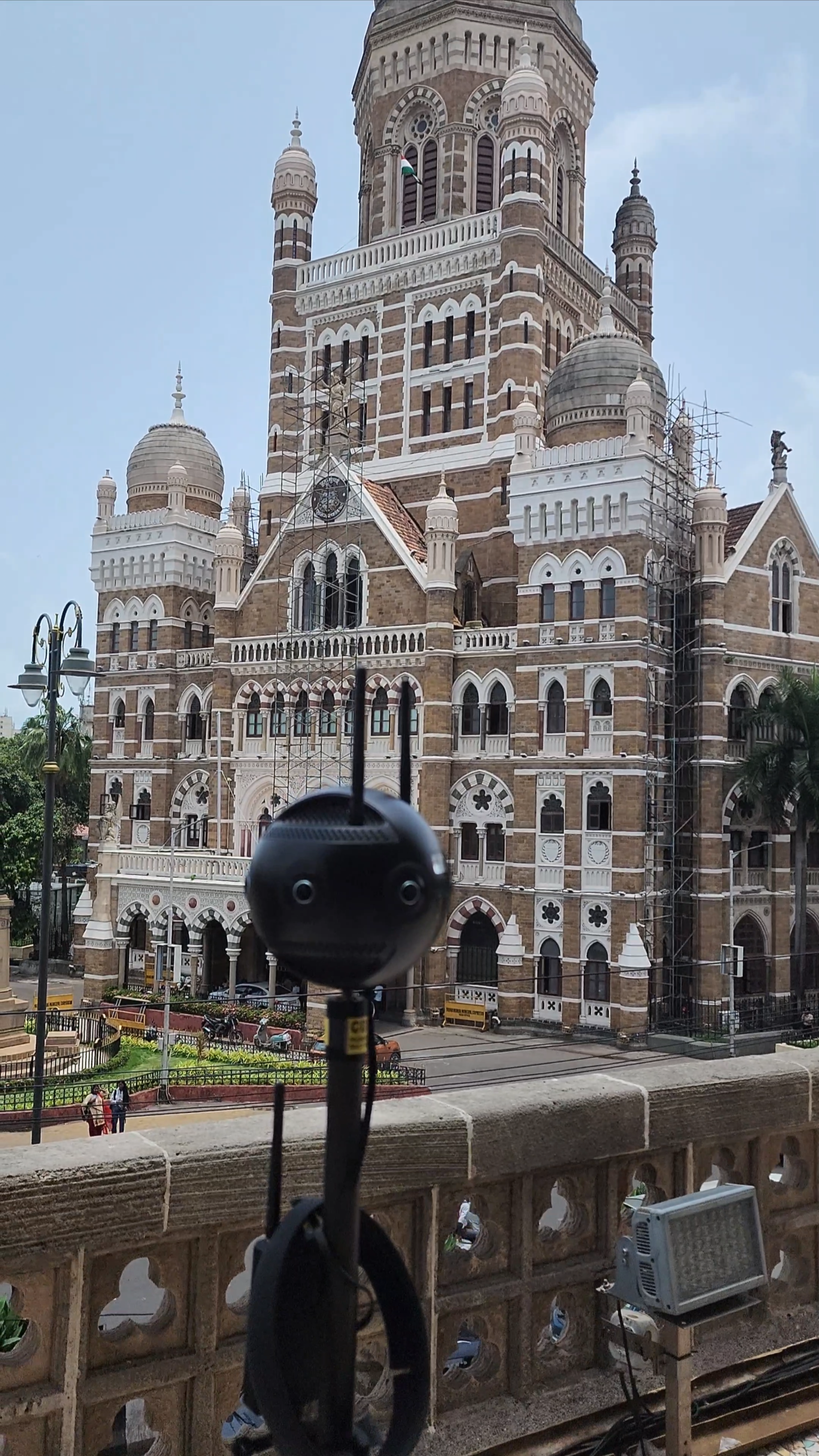
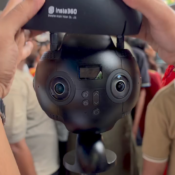
Insta360 Pro 2 positioned for 360° videography during our CSMT Mumbai production.
Insta360 Pro 2 setup during our CSMT Mumbai production.
Module 2: Hardware Engineering & The 7-Card Data Pipeline.
The Insta360 Pro 2 runs on a 7-card recording architecture. Understanding this is non-negotiable before any professional shoot.
6 MicroSD Cards – one per lens, recording independently at high data rates. If any single card drops write speed, that lens can drop frames while the other lenses continue recording. You can end up with footage that becomes difficult to stitch correctly.
1 Full-Size SD Card – handles proxy files, stabilization gyro metadata and other supporting production data.
Card Certification Standard: V30 / U3 / A2 minimum.
Anything below this and write-speed instability becomes a real on-set risk.
Thermal Management
Continuous 8K recording generates significant heat. Cooling settings should be configured before the shoot. For long-form productions, continuous power can also reduce interruptions caused by battery changes.
Always verify nodal alignment and sensor calibration before every shoot.
A small calibration problem can become much more visible once six camera feeds are stitched into one 360° image.
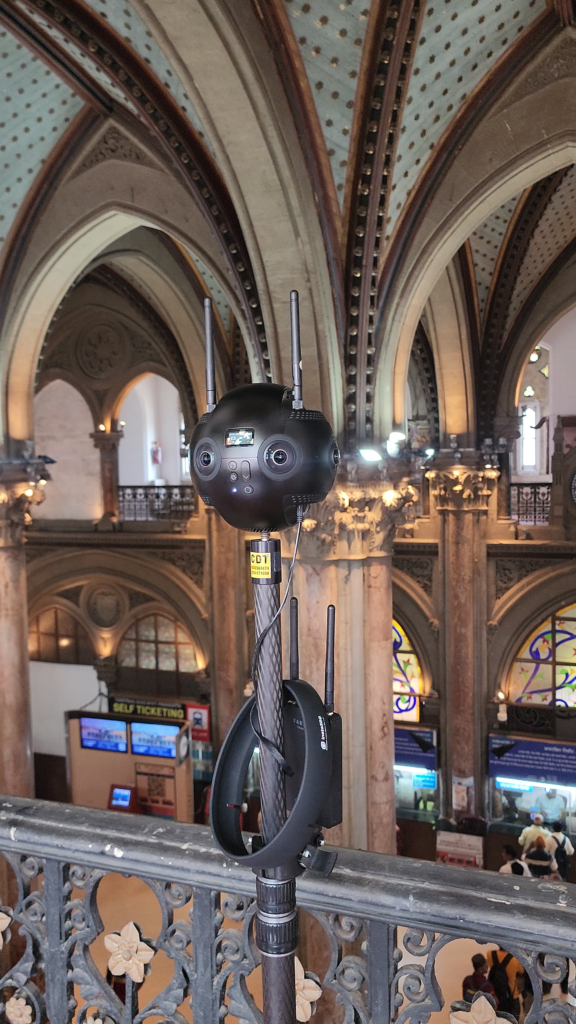
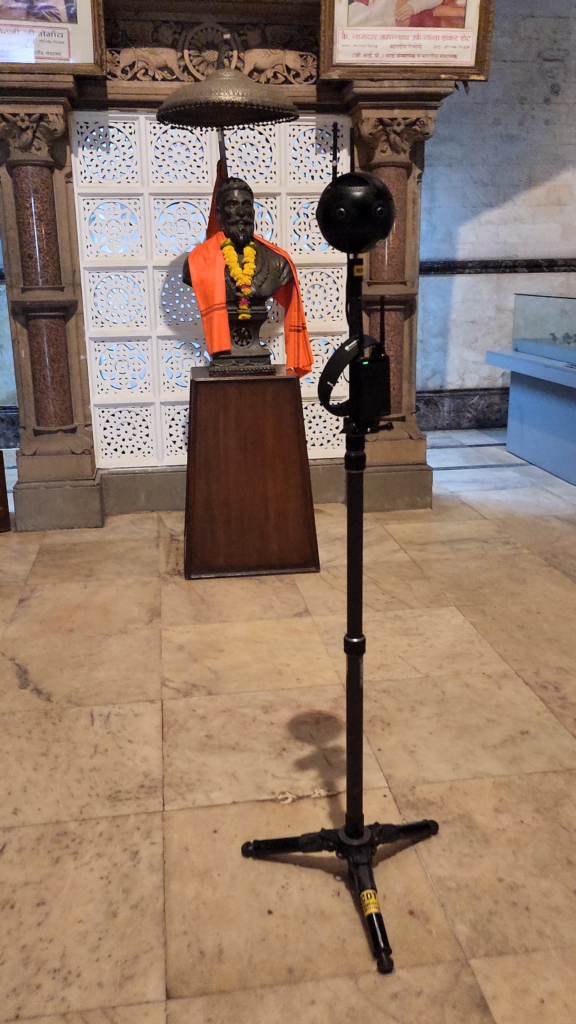
Insta360 Pro 2 camera and FarSight monitoring system set up inside a historic heritage building for an immersive 360° videography production.
The Insta360 Pro 2 positioned inside the main interior during the CSMT shoot.
REAL EXPERIENCE – Camera Setup
At CSMT, we were moving the camera between different architectural environments rather than working in one controlled studio-like space.
The BTS images show the difference clearly – the same camera had to work inside the grand interior, on staircases, across elevated areas, and outside around the building.
That makes equipment preparation important. With professional Insta360 videography, the camera setup has to be ready before moving into the next section because repositioning a 360° system is not as simple as reframing a normal camera.
Module 3: On-Set Operations, FarSight & The Invisible Crew.
This is the challenge nobody talks about enough.
The Insta360 Pro 2 has 6 lenses covering a full 360° sphere.
There is nowhere for the camera operator, director, or crew member to stand permanently without potentially appearing in the footage.
Everyone has to leave the camera’s immediate frame before every take.
FarSight Transmitter Setup
- Ground-to-ground range up to 300 meters
- In large reinforced structures, antenna positioning can affect signal performance
- Real-time preview allows the camera and production to be monitored remotely
The Zero-Nadir Rigging Protocol
- Use slim monopods with small bases
- Keep the camera position stable
- Plan nadir patching before the shoot
- Check the tripod/monopod footprint carefully
REAL EXPERIENCE – Moving Through CSMT
One of the clearest challenges from our CSMT production was simply getting the camera into the right position.
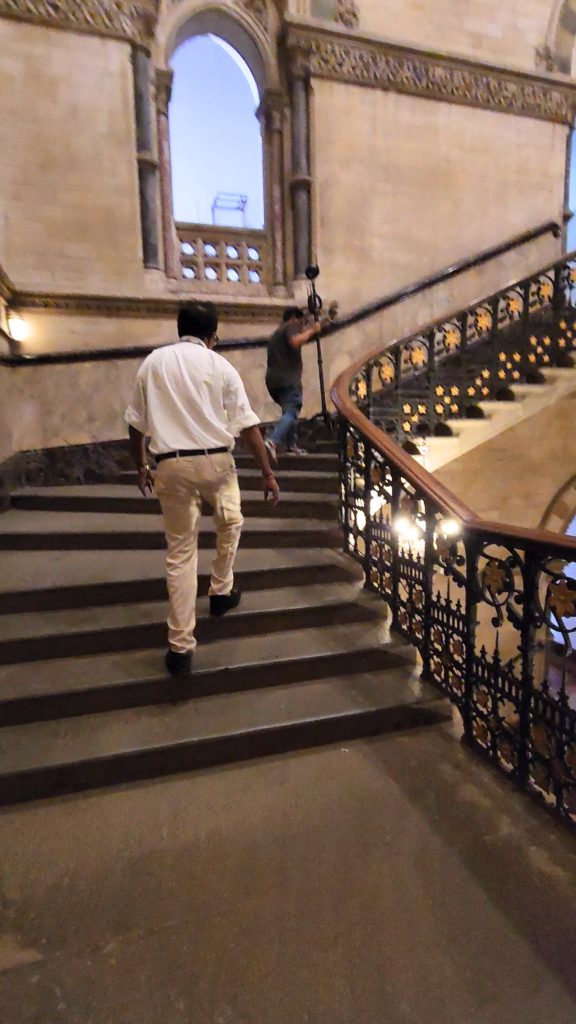
Our camera team capturing a smooth moving shot on a historic staircase during an Insta360 videography production in Mumbai.
Moving the Insta360 setup through the main staircase at CSMT.
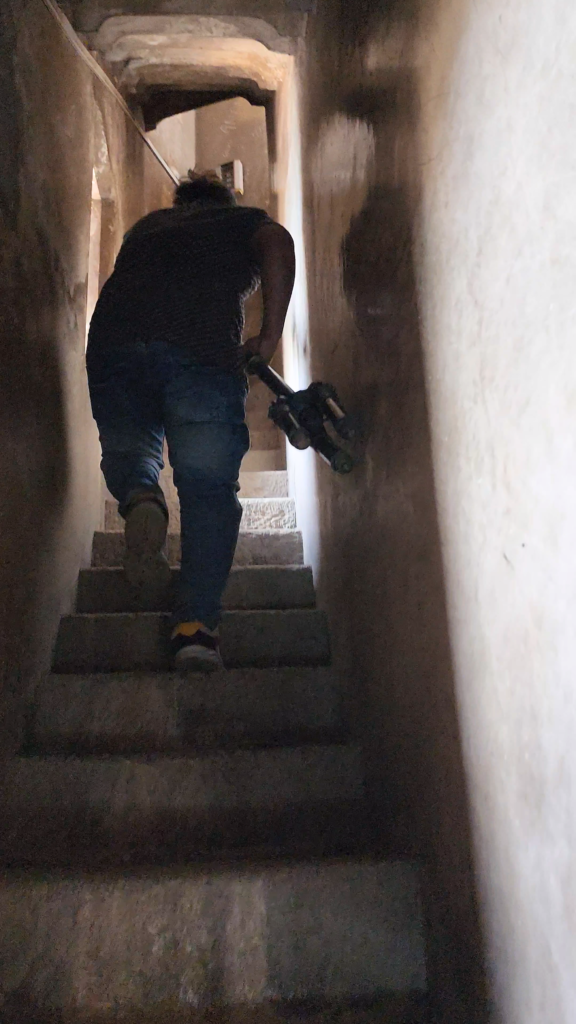
Our crew carefully carrying the Insta360 Pro 2 setup through a narrow staircase during the CSMT Mumbai production.
Navigating a narrow staircase with the camera setup during the production.
Some areas were wide and open, while others required the equipment to be carried through narrow stairways.
This is one of the practical differences between ordinary 360° shooting and professional production. You have to plan not only where the camera will shoot, but also how the complete setup will reach that position.
Module 4: Invisible Lighting Architecture.
Traditional lighting becomes difficult in 360° production.
Light stands, softboxes and cables cannot simply be hidden outside the frame.
Every piece of equipment around the camera can potentially become part of the 360° environment.
The Hidden Fixture Technique
- Wireless LED sources can be concealed where appropriate
- Architectural cove lighting can become the primary ambient source
- Stands and visible cables should be avoided wherever possible
Managing the Kelvin War
Luxury interiors often contain competing colour temperatures – daylight through windows versus warm interior lighting.
- Lock white balance manually before the shoot
- Control window exposure carefully
- Avoid uncontrolled highlight clipping
- Balance the interior and exterior environment before recording
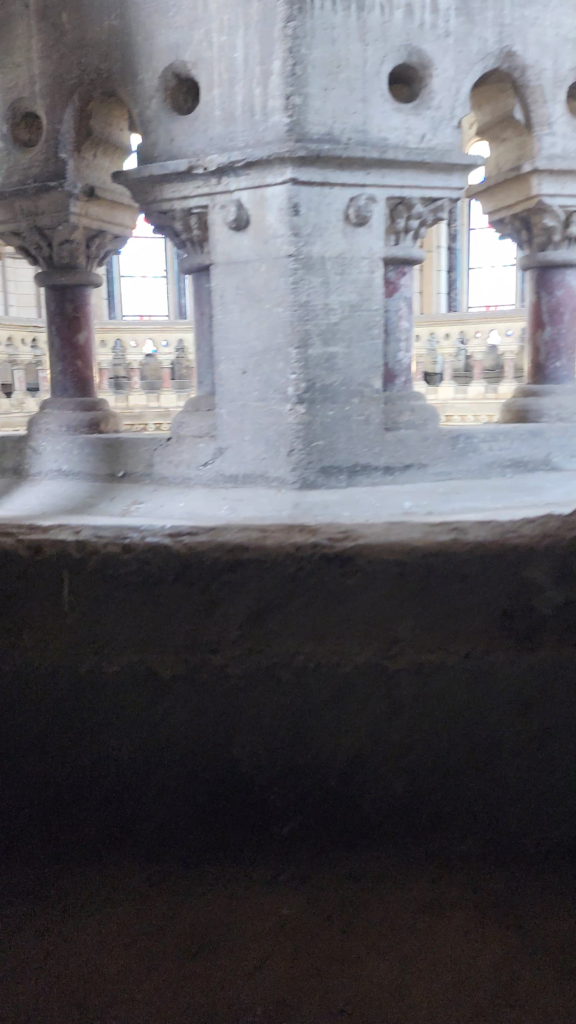
Close-up view of the historic stone columns and architectural details captured during our CSMT Mumbai 360° production.
The stained-glass windows at CSMT created a strong contrast between the interior architecture and incoming daylight.
REAL EXPERIENCE – CSMT Interior Lighting
CSMT was a particularly interesting location because the architecture itself provided multiple lighting conditions.
The interior included warm architectural lighting, bright windows and stained-glass sections.
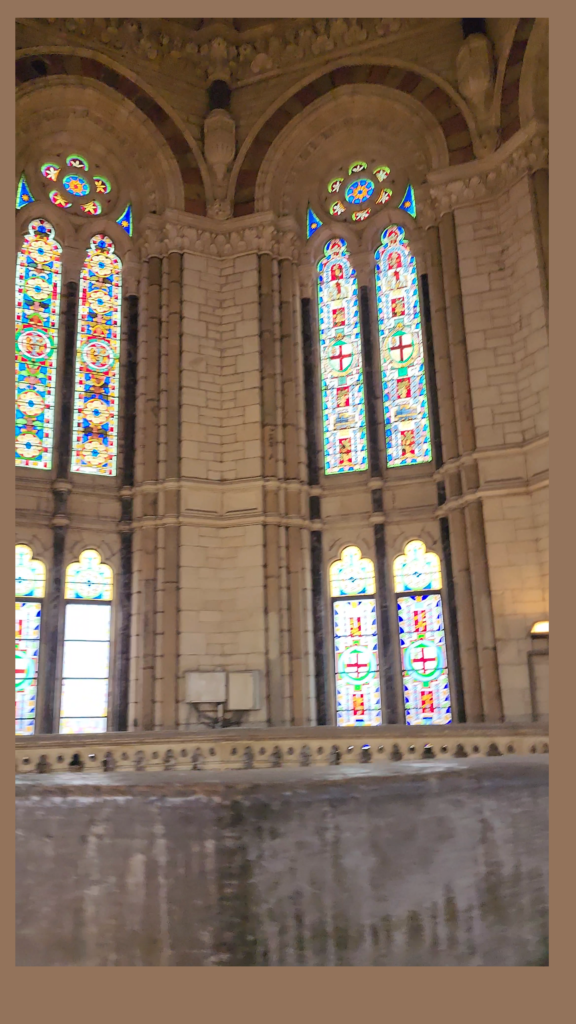
Vibrant stained glass windows and detailed heritage architecture captured during our 360° production at CSMT Mumbai.
In a normal camera shot, you can choose one composition and control what appears in the frame. With 360° videography, the viewer can turn in any direction.
That makes exposure and lighting decisions much more important because there is nowhere to simply “crop out” a difficult part of the environment.
Module 5: Smooth Camera Movement & Motion Rigging.
In a VR headset, bad camera movement doesn’t just look bad.
It can make the viewing experience uncomfortable.
Jerky pans, footstep bounce and sudden direction changes can be physically uncomfortable for a viewer wearing a headset.
The Rule: Single-Axis, Continuous Movement
For moving 360° shots, the objective is controlled and predictable movement.
Motorized dolly and remote rover systems can be used where the location and production requirements allow.
REAL EXPERIENCE – Moving Through the Architecture
Our CSMT BTS footage shows one of the practical sides of 360° movement.
Our crew carefully carrying the Insta360 Pro 2 setup through a narrow staircase during the CSMT Mumbai production.
The camera had to move through a large staircase environment while maintaining a controlled path.
The challenge was not simply “walking with a camera.” With a 360° camera, the operator and equipment are part of a much larger spatial system.
The movement has to feel intentional because the viewer can look in any direction while the camera is moving.
Module 6: Immersive Ambisonic 360° Spatial Audio
Flat stereo audio can break VR immersion immediately.
In a headset, the viewer rotates their head – and in a properly produced VR experience, the audio environment should support that sense of spatial presence.
The kitchen should sound like it is coming from the kitchen.
The balcony should sound like it is outside.
Dedicated Ambisonic Audio
For premium productions, a dedicated 4-channel Ambisonic microphone can be used depending on the production requirements.
A-Format to B-Format Encoding
The raw Ambisonic capture must be encoded correctly and sync-locked to the visual heading before the edit begins.
Lose this relationship and the audio direction can become incorrect for the headset viewer.
REAL EXPERIENCE – Why Location Audio Matters
A location like CSMT is not acoustically neutral.
There are large open spaces, hard architectural surfaces, staircases and multiple levels.
Our camera team capturing a smooth moving shot on a historic staircase during an Insta360 videography production in Mumbai.
The interior environment during the CSMT production.
For an immersive production, the objective is not simply to record the image. The final experience should communicate the scale and atmosphere of the location as naturally as possible.
Module 7: Post-Production Pipeline & Stitching Mastery.
The Proxy-First Workflow
Do not stitch 8K uncompressed files until the edit is locked.
The supporting proxy workflow allows the edit to remain lighter and faster. Once the edit is final and approved, the full-resolution 8K files can be processed.
This workflow can save significant time on large productions.
Optical Flow Stitching – Insta360 Stitcher vs. SGO Mistika VR
- Insta360 Stitcher provides a fast stitching workflow
- Advanced optical-flow workflows can provide more control around difficult seams
- Manual correction can become important around door frames, architecture and subjects crossing lens boundaries
Color Grading 360° Footage
The multiple lenses of a professional 360° camera can produce small exposure and colour differences.
These need to be normalized before the final global grade.
Shoot in the appropriate log profile where required and grade to the intended delivery colour space.
REAL EXPERIENCE – Architectural Stitching
CSMT gave us another important consideration: complex geometry everywhere.
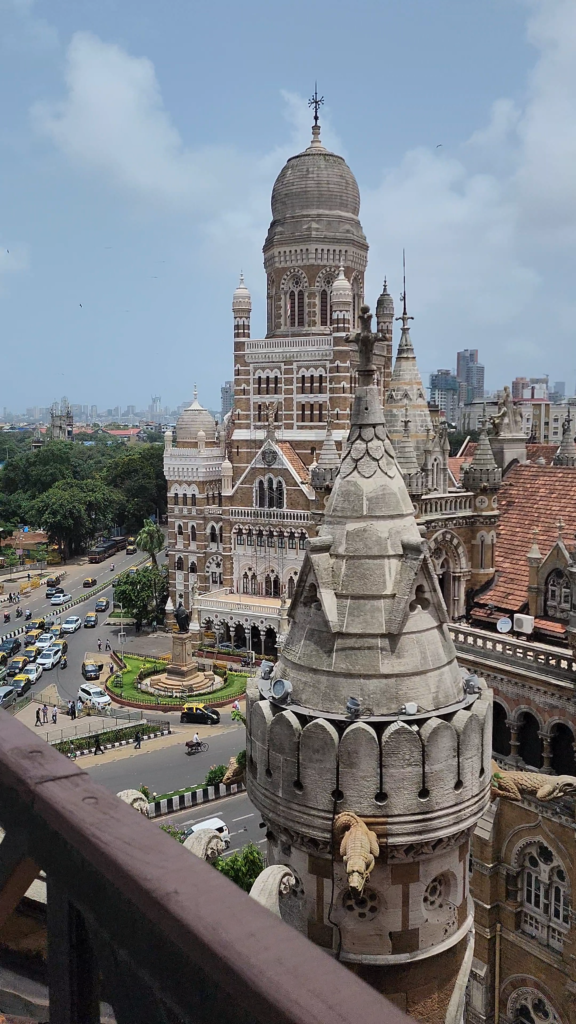
Detailed exterior view of CSMT Mumbai and its historic architectural structures captured during our 360° production.
Camera positioning against the symmetrical interior architecture at CSMT.
Arches, columns, railings and repeating architectural lines make stitching errors much easier to notice.
When the environment contains strong straight lines and repeating patterns, even a small stitching problem can become visually obvious.
This is why camera alignment and careful post-production are critical in professional Insta360 videography.
Module 8: Commercial Distribution & Client Deliverables
VR Headset Native Deployment
- Meta Quest 3 and Quest Pro: immersive 8K 3D stereoscopic delivery where applicable
- Apple Vision Pro: spatial viewing workflows where supported by the production format
WebGL & Interactive Walkthroughs
- 3DVista and Kuula web engines
- Multi-resolution delivery
- Progressive loading for web-based experiences
Google Street View Pro Integration
360° content can also be prepared for Google Street View and interactive location experiences depending on the project.
For commercial spaces, the same production can become part of a wider spatial marketing strategy.
Module 9: Insta360 Pro 2 Videography Price in India
One of the most common questions people ask is:
“What is the Insta360 Pro 2 videography price in India?”
The answer depends on whether you are asking about the camera purchase price or the professional videography service price.
For a professional Insta360 Pro 2 videography shoot, our typical shoot pricing is around ₹60,000–₹80,000 per shoot, depending on the production requirements.
The final price can vary based on:
- Shoot duration
- Location and travel
- Number of spaces
- 8K 2D or 3D requirements
- Camera movement
- Lighting requirements
- Audio requirements
- Stitching and post-production
- Interactive 360° tour requirements
- Final delivery formats
So, Insta360 Pro 2 videography price is not simply a camera rental number. A professional production includes the camera, crew, planning, setup, shooting, data management, stitching, and final delivery.
Module 10: Field Notes from a Real CSMT Mumbai Production
One of our real Insta360 Pro 2 productions took us to Chhatrapati Shivaji Maharaj Terminus in Mumbai.
The location was completely different from a controlled interior shoot.
We worked across detailed heritage interiors, large staircases, elevated walkways and exterior architectural sections.
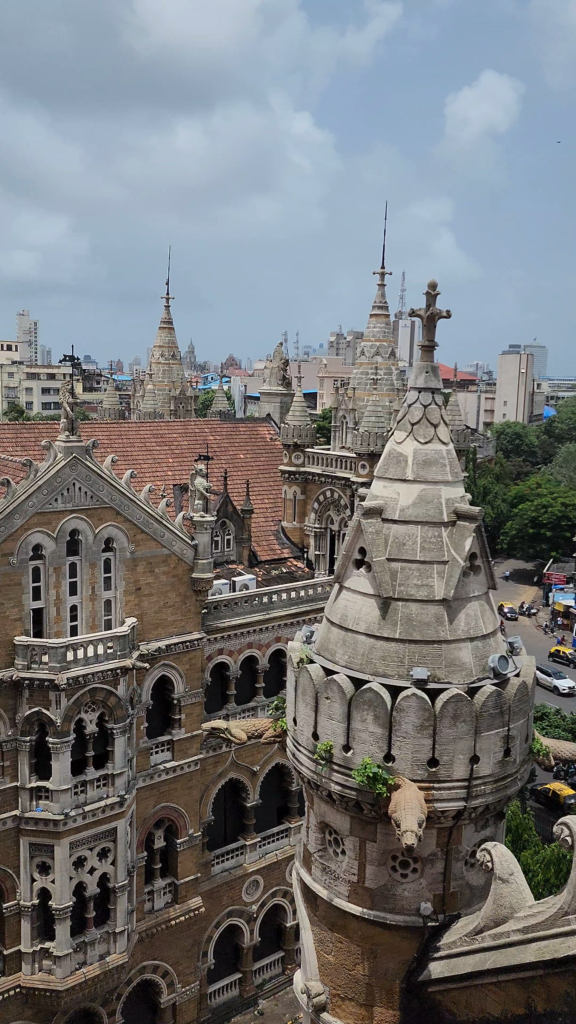
Detailed view of Mumbai’s historic heritage architecture captured during an immersive 360° videography production.
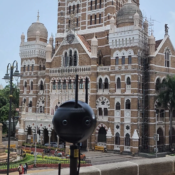
Exterior architectural view captured during the CSMT production.
The biggest lesson was that 360° production requires you to think about the entire environment, not just the subject.
Working at Height
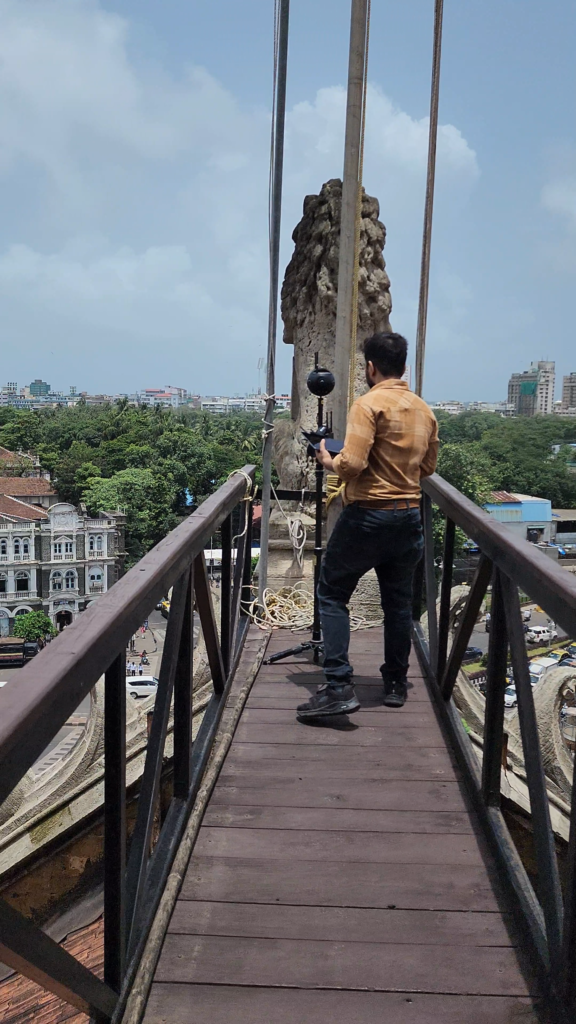
Insta360 Pro 2 camera setup during a 360° videography shoot on a heritage building in Mumbai.
Insta360 Pro 2 positioned on an elevated section of the CSMT structure.
For elevated exterior sections, camera placement required additional attention because the environment extended in every direction.
The camera position had to work with the architecture while keeping the setup stable and controlled.
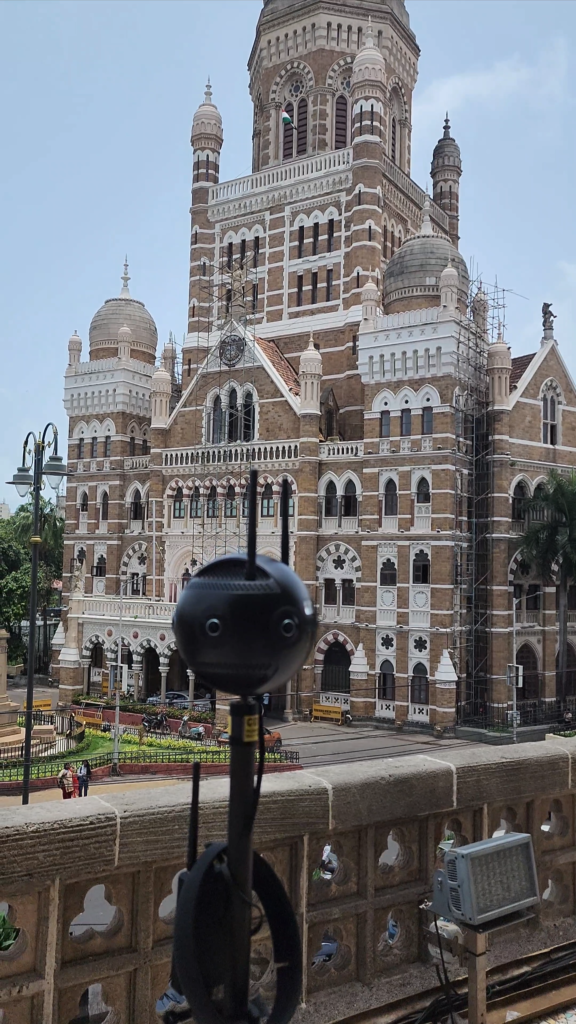
Insta360 Pro 2 positioned on a rooftop during a 360° videography shoot of Mumbai’s historic heritage architecture.
Camera positioned near an architectural sculpture during the exterior production.
The camera was positioned close to architectural elements to capture the scale and surrounding environment.
Interior Production
Insta360 Pro 2 camera and FarSight monitoring system set up inside a historic heritage building for an immersive 360° videography production.
Insta360 Pro 2 setup during exterior coverage.
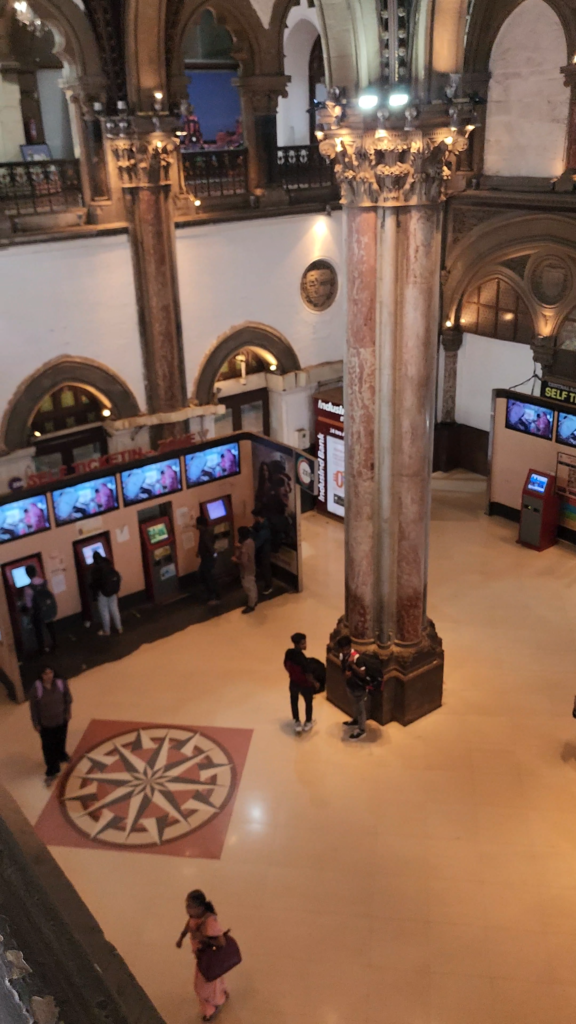
Interior view captured during an Insta360 Pro 2 360° videography shoot inside a historic Mumbai building.
Professional Insta360 Pro 2 setup inside the CSMT interior.
Inside the station, the camera was positioned among the architectural details rather than simply shooting from an empty centre point.
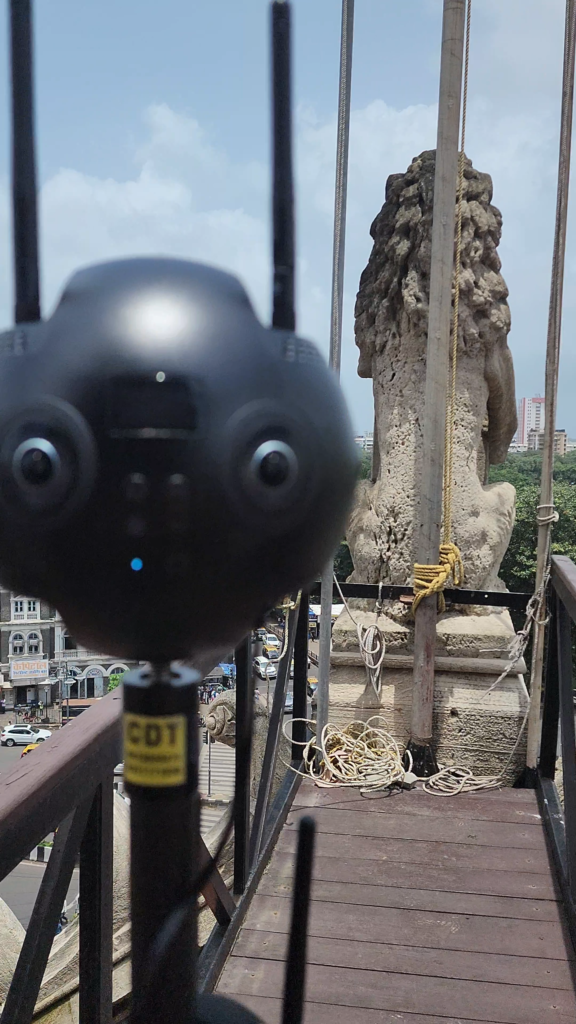
Insta360 Pro 2 positioned on a rooftop platform to capture immersive 360° footage of a historic Mumbai landmark.
The arches, columns, railings, stained glass and multiple levels created a naturally immersive environment.
The Real Lesson
The CSMT shoot reinforced something we have learned through 360° production:
The camera is only one part of the job.
The real work is choosing the right position, moving the equipment safely, managing the environment, monitoring the recording and then turning multiple camera feeds into one seamless experience.
That is the difference between simply shooting 360° footage and professional Insta360 videography.
Module 11: Master Shoot Day Checklist
| Category | Action | Standard |
| Lenses | Clean all 6 lens surfaces | Zero dust, zero smudge |
| Cards | Format all recording cards | V30/U3/A2 verified |
| FarSight | Sync transmitter and receiver | Preview confirmed |
| Audio | Stage Ambisonic mic where required | Sync locked |
| Lighting | Conceal production lighting | Zero unnecessary stands in frame |
| Thermal | Configure cooling | Power checked |
| Nadir | Confirm monopod blind spot | Nadir planned |
| Backup | Backup raw assets on-set | Two separate drives |
| Calibration | Verify nodal alignment | Calibration confirmed |
| Safe Distance | Check subjects and walls | Minimum safe distance maintained |
| Movement | Check movement path | Smooth and obstruction-free |
| Environment | Check crew visibility | Crew positions planned |
Module 12: Turn Your Space Into an Immersive Sales Asset
A static photo shows what a space looks like.
An 8K VR walkthrough makes the viewer feel like they are already inside it.
For luxury real estate developers, interior architects, high-end showrooms and architectural spaces across Mumbai, that difference can change how a prospect experiences the property before the physical site visit.
From CSMT to Luxury Real Estate
Our CSMT production demonstrated why 360° capture works particularly well for architecture.
The viewer is not restricted to one camera angle.
They can look up at the ceiling.
Look across the staircase.
Look at the columns.
Look through the windows.
And understand the relationship between different parts of the space.
That same principle can be applied to:
- Luxury sample flats
- Penthouses
- Commercial showrooms
- Hotels
- Heritage properties
- Interior design projects
- Architectural spaces
- Real estate developments
Cinematic360 produces professional Insta360 videography and 8K VR productions for high-end spaces across Mumbai and India.
Explore: 360-degree virtual tours, Matterport 3D tours, real estate photography and drone photography.
Book an 8K VR Production Consultation with Cinematic360.
At the end, before the CTA:
Frequently Asked Questions
How much does Insta360 Pro 2 videography cost in India?
Professional Insta360 Pro 2 videography typically starts around ₹60,000–₹80,000 per shoot, depending on the location, duration, production requirements, number of spaces and final deliverables.
How is Insta360 Pro 2 different from a normal 360° camera?
The Pro 2 is designed for professional 360° production, including high-resolution 360° capture and workflows intended for immersive VR applications.
Can Insta360 Pro 2 be used for real estate?
Yes. It can be used for luxury residences, sample flats, commercial properties, showrooms, hotels and architectural spaces where immersive viewing is valuable.
What affects the price of an Insta360 Pro 2 shoot?
Location, shooting duration, number of spaces, 8K requirements, movement, lighting, audio, stitching, post-production and final delivery format can all affect the production cost.
[…] of the most demanding 360 videography productions we have […]