


Most interior spaces that feel “off” have one thing in common.
Not the wrong furniture. Not the wrong colour. The wrong numbers.
The 3-5-7 rule in interior design is a principle that governs how many items, colours, or elements you group together in a space. When you follow it, rooms feel intentional and balanced. When you ignore it, even expensive rooms feel cluttered or incomplete. If you have ever walked into a space and felt something was wrong but could not explain what — this rule is usually why.
Quick Answer: What Is the 3-5-7 Rule in Interior Design?
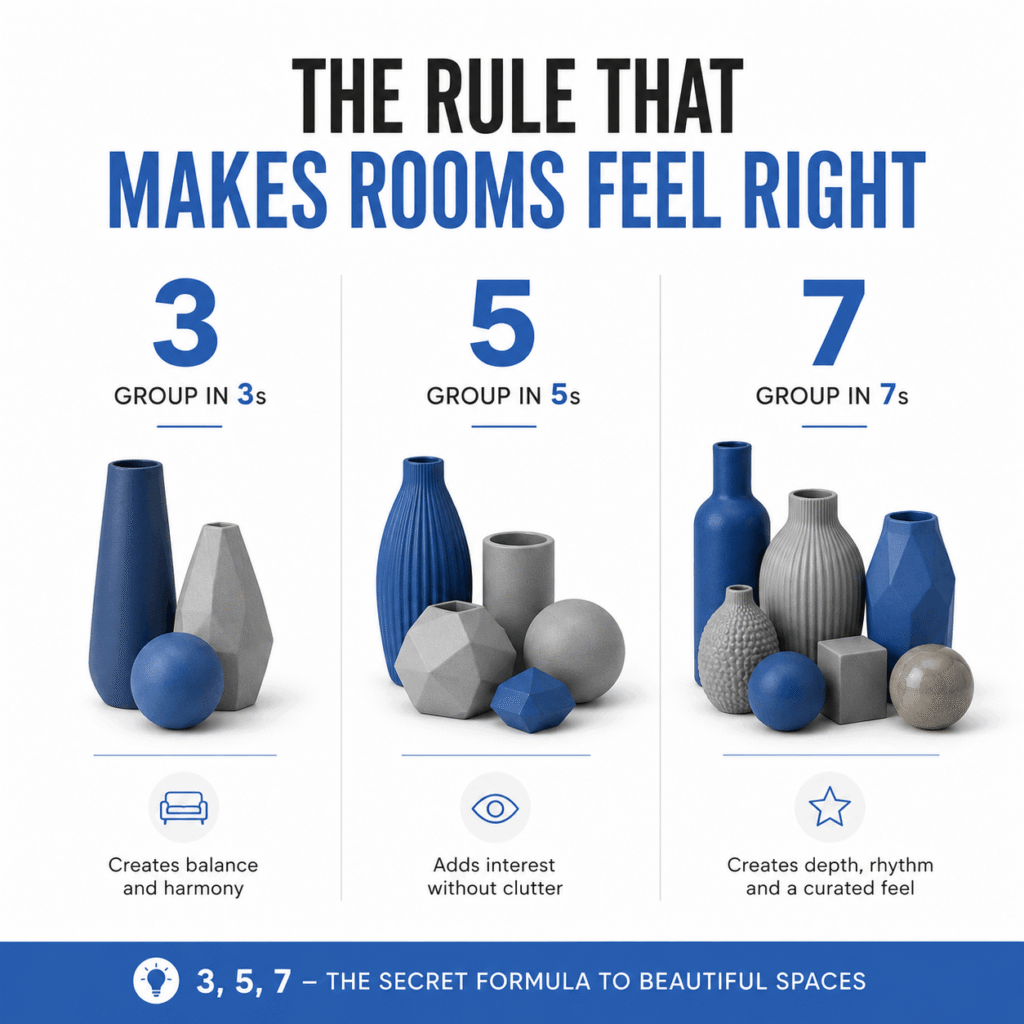
Odd numbers create visual flow. Even numbers create visual stops.
The 3-5-7 rule states that decorative objects, colours, and design elements should be grouped in odd numbers — specifically 3, 5, or 7 — to create visual harmony.
Odd-numbered groupings are more pleasing to the human eye than even numbers. A group of 3 cushions looks balanced. A group of 4 looks like someone forgot to add one or forgot to remove one. This is not a personal preference — it is how the brain processes visual symmetry and tension.
The rule applies to cushions on a sofa, artwork arrangements on a wall, plants in a living room, pendant lights above a kitchen island, and objects on a console table.
Why the 3-5-7 Rule Works: The Psychology Behind It.
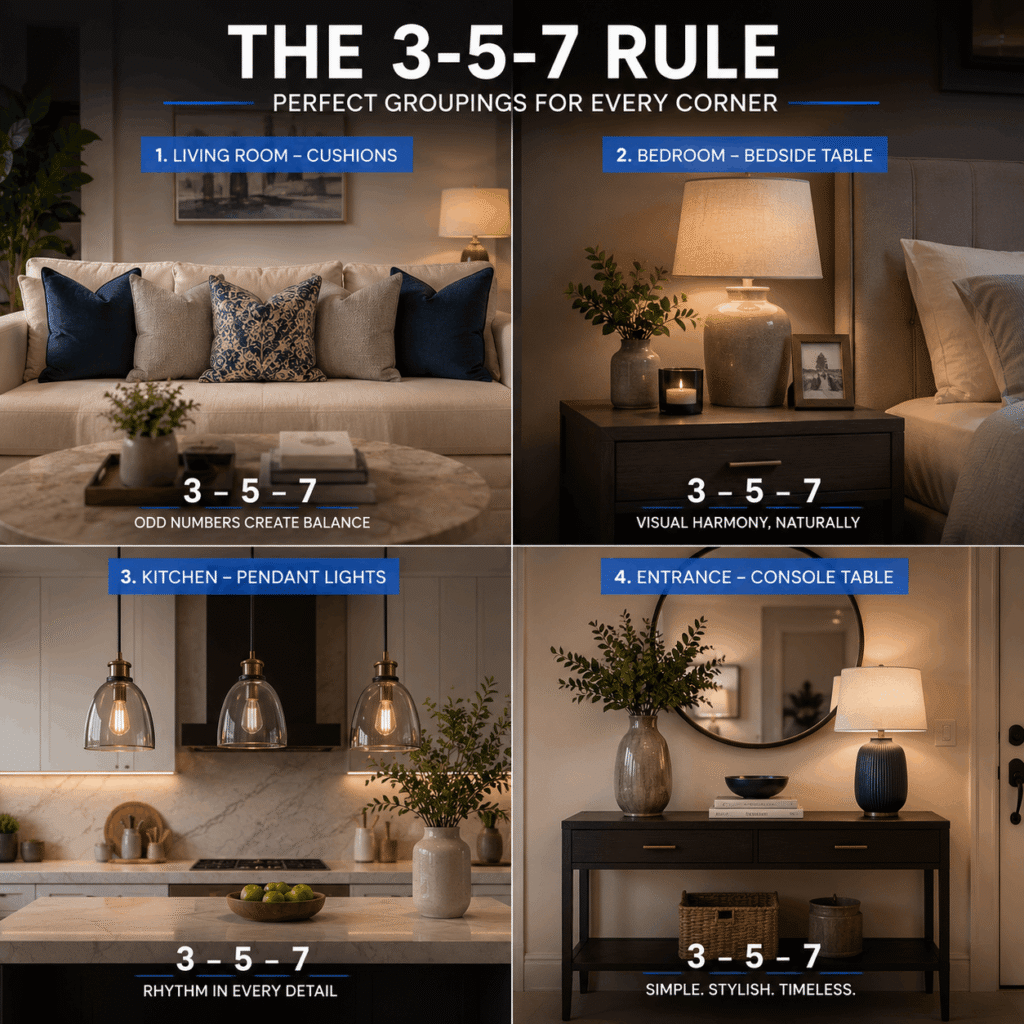
The rule works in every room. Here is what it looks like in practice.
Our brains are pattern-recognition machines.
Even numbers create instant symmetry — which feels formal and rigid. Odd numbers create micro-tension — a small visual question the brain resolves by moving across the grouping. That movement is what we call “visual interest.” It is why museum curators, photographers, and set designers all work in odd numbers instinctively.
Three is the smallest odd grouping that creates depth. Five adds complexity without chaos. Seven is the upper limit — beyond that, groupings start feeling cluttered rather than dynamic.
Interior designers who understand this principle do not just make rooms look good. They make rooms feel right. And that feeling is what clients remember, photograph, and refer to their friends.
How to Apply the 3-5-7 Rule in Interior Design Room by Room
Living Room
Start with your cushions. Three cushions in two complementary textures on a sofa is the foundation. Then apply the rule to your coffee table — three objects of different heights create a tableau that feels styled but natural.
Bedroom
Bedside table styling is where most bedrooms fall apart. Two matching items on both sides feels hotel-generic. Instead, try three elements on each side — a lamp, a small plant, and one personal object. The scale difference between them is what creates the visual story.
For cushion arrangements on a bed, five is the magic number. It allows for layering — larger Euro pillows at the back, standard pillows in the middle, and one accent cushion or bolster at the front.
Kitchen and Dining
Pendant lights above a kitchen island almost always look best in odd numbers. Three pendants over a standard island. Five over a longer run. The spacing and proportion matter, but the number is where to start.
For open shelving in a kitchen, group items in threes — a small plant, a stack of books, and a ceramic object. Resist the urge to fill every inch.
Entrance and Hallways
The entrance is the first impression of a home. A console table styled with three objects of varying height — a tall vase, a medium lamp, and a low bowl — tells a story in seconds. It signals that someone with taste lives here.
Expert Insights: Where Designers Go Wrong With the 3-5-7 Rule
The most common mistake is applying the rule to number of items but ignoring scale variation.
Three identically sized objects in a row is still boring. The rule works best when the three objects have a clear height hierarchy — tall, medium, short. This creates a visual triangle, which is the most stable and pleasing shape the eye can follow.
This is where professional interior photography becomes essential. A skilled photographer understands composition — they will instinctively position your 3-5-7 groupings within the frame to maximise the visual impact. Your work deserves to be seen the way it actually looks.
Real-World Examples of the 3-5-7 Rule in Action
Example 1: The Overdone Living Room
A Mumbai-based interior designer completed a premium 4BHK in Bandra. The space was beautiful — marble finishes, custom joinery, art collected from local galleries. But the Instagram photos performed poorly. The issue was the styling: two floor lamps, four cushions, an even shelf arrangement. Everything was symmetrical and nothing had tension.
Example 2: Real Estate Developers and the 3-5-7 Rule
Real estate developers in Mumbai who stage model flats are increasingly using the 3-5-7 rule as a standard. Buyers make faster decisions in spaces that feel “move-in ready.” Odd-number groupings signal that the space is lived in and aspirational — not a showroom.
A 3D Matterport virtual tour of a well-styled model flat using the 3-5-7 rule consistently outperforms a basic tour of the same flat without thoughtful styling. Buyers spend more time exploring. They send the link to family members. They come back for a second viewing.
Common Mistakes When Using the 3-5-7 Rule
Using the rule without scale variation. Three identical candleholders in a row is not the 3-5-7 rule. It is repetition. Vary the heights.
Applying it only to tabletop styling. The rule governs colour groupings, furniture arrangements, and light fixture counts too — not just decorative objects.
Stopping at 7. More than 7 objects in a grouping almost always reads as clutter. Edit ruthlessly.
Photographing after styling but before adjusting for the lens. What looks balanced to the eye can look unbalanced through a wide-angle lens. Always preview through the camera before finalising the arrangement.
Forgetting about negative space. The 3-5-7 rule is about what you include. Negative space — what you leave empty — is what gives those groupings room to breathe. A styled shelf with too many groupings defeats the purpose.
Why Knowing the Rules Is Only Half the Battle
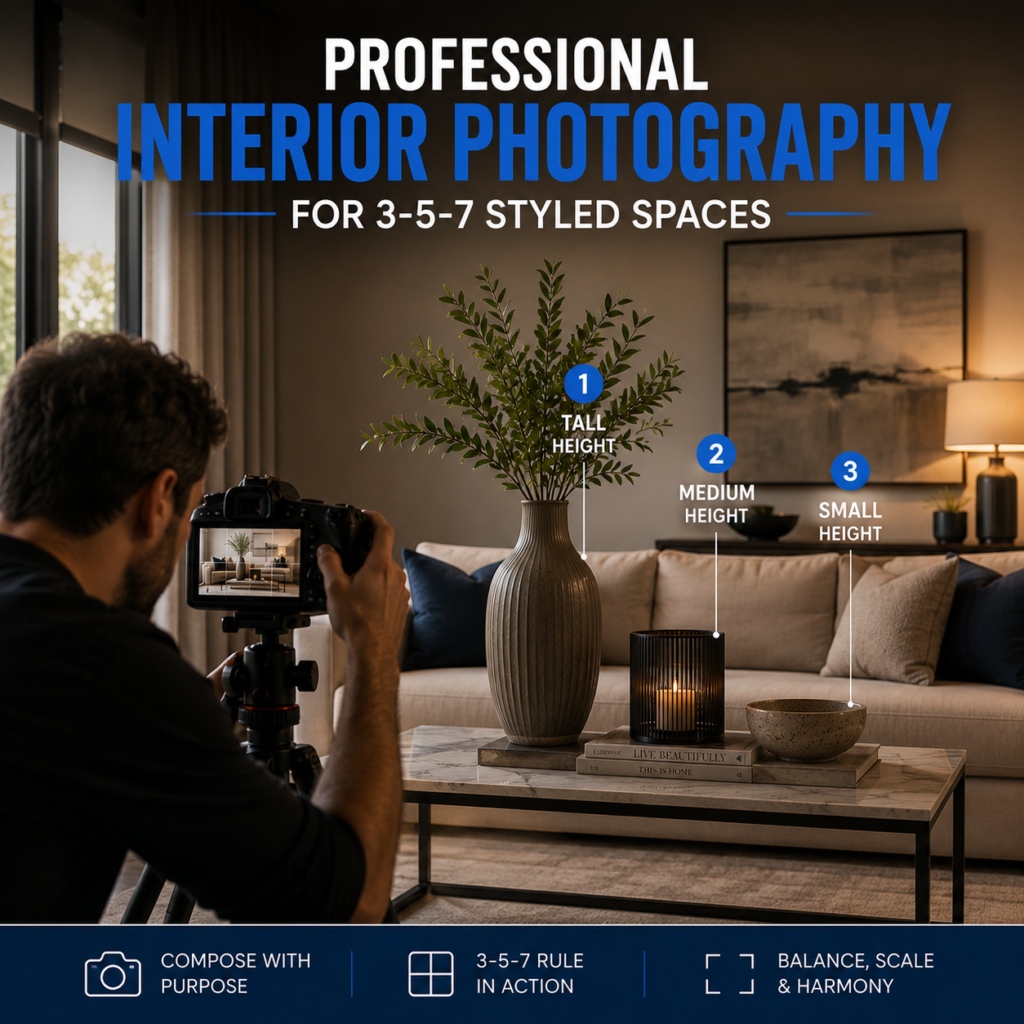
Great styling and great photography — one without the other leaves money on the table.
Interior designers who master principles like the 3-5-7 rule build stunning spaces.
But the ones who build successful businesses understand that the space needs to be seen. Every beautifully balanced room you style is a marketing asset — or it is just another project that ends when the client moves in.
A drone aerial shot of a completed property exterior. A walkthrough video that shows the flow from room to room. A 3D tour on your website where prospective clients can explore a project before they call you. These are not extras. They are the difference between a designer who gets referrals and one who is always looking for the next client.
What is the best way to showcase a 3-5-7 styled interior online?
Professional photography captures the static beauty of a styled space. For maximum impact, a 360-degree virtual tour or a 3D Matterport scan allows viewers to experience the spatial balance and styling details interactively — far more effectively than a single photo.