
The First Bite Is Always Visual
You’ve completed it on your own.
In less than ten seconds, thumb through twelve biryani listings on the Zomato screen. It’s not because the description was more accurate that you stop. Not because it received a higher rating.
because you were hungry after looking only one picture. The other eleven didn’t either.
That’s the whole game.
You shouldn’t use food photos as a marketing garnish. It occurs before your customer has even opened your menu and is the first bite they take.
The choice to place an order is made in less than two seconds, whether on Instagram, Swiggy, or a laminated table card at your restaurant. based on just one frame.
If that frame is flat, dim, or shot on a phone propped against a water glass — you’ve already lost the sale. This is why food photography has quietly become one of the highest-leverage investments a Mumbai restaurant or cloud kitchen can make.
Why Professional Food Photography Matters
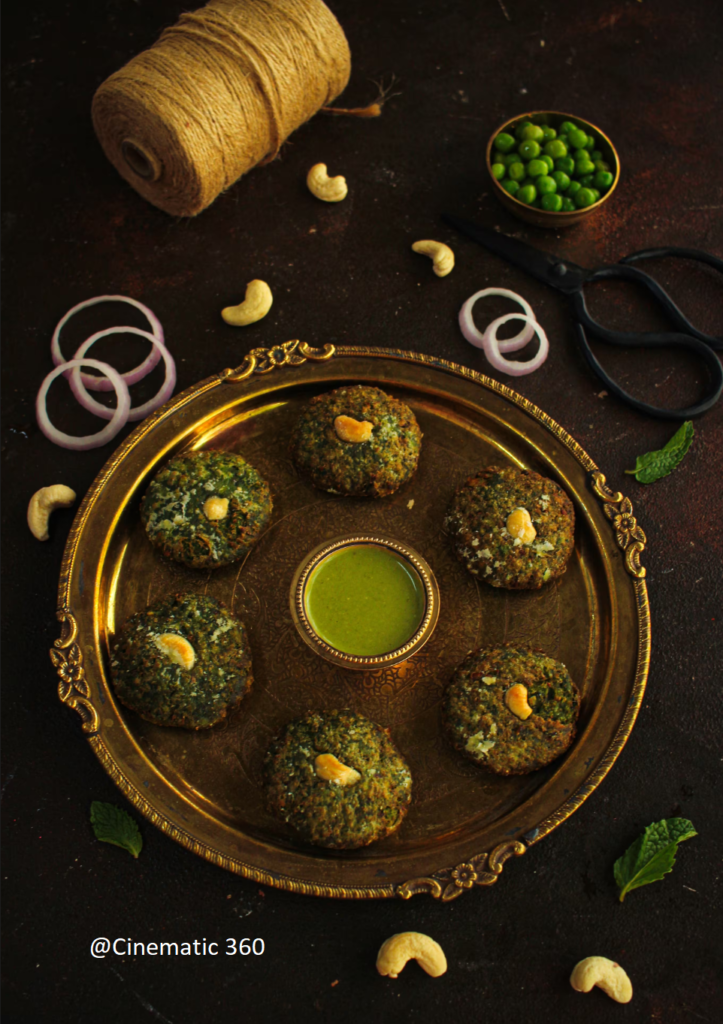
Crispy spinach and green pea Hara Bhara Kababs garnished with cashews, served with mint chutney on a vintage brass thali—captured in a dark, rustic style by Cinematic360.
Most restaurant owners treat photography as an afterthought. Something the manager handles between shifts with a phone camera. The problem isn’t effort it’s physics. Phone cameras flatten texture. They wash out colour under kitchen tube lighting. They can’t hold focus on a dish the way a proper macro lens can. Here’s what that actually costs your business.
1.Driving Instant Appetite Appeal & Impulse Conversions
Hunger is triggered by detail. The crackle of a fried crust. The glisten on a butter chicken gravy. The visible pull of melted cheese stretching off a pizza slice. High-resolution, correctly lit food photography captures those textural cues in a way a phone snap simply cannot.
The eye reads glisten as freshness. Freshness reads as “order now.”
A flat, underlit photo doesn’t just fail to sell. It can actively signal that the dish is stale or unappetizing even if it tastes extraordinary. While clean, well-lit top-down photography undeniably makes food look more appetizing and structured on digital menu apps, tracking exact order changes requires actual backend analytics, not visual inference from a photo. My focus remains on the technical execution—lighting setups, focal depth, staging, and composition that make the food look its best.
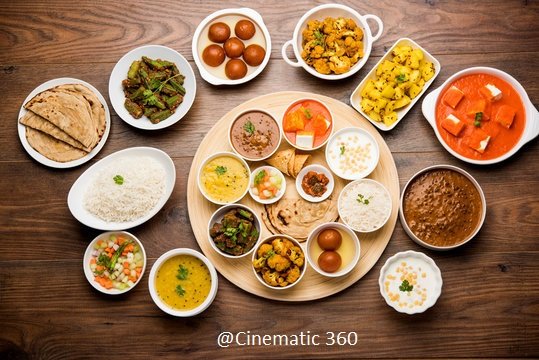
90° Flat Lay Overhead:
When geometry, variation, and general arrangement are the visual focal points, I employ this. Thalis, pizzas, and multi-bowl spreads that have all of the color and texture on the top surface work best with it. Dish height is entirely lost, yet edge-to-edge sharpness is achieved throughout the screen.
45° Hero Angle:
When a food has vertical depth, such as deep noodle bowls, tall drinks, or stacked burgers, I move to 45°. This viewpoint simulates how a customer might truly see food at a restaurant table. It enables you to take pictures with a larger aperture, smooth background blur, and light bouncing off the food’s side profile.
Photographer’s Rule of Thumb: > If the dish relies on shape and spread, shoot flat lay overhead. If it relies on height and layers, shoot at 45°.
2. Building Brand Trust & Premium Pricing Power
The majority of restaurant owners don’t want to hear this fact. Your pricing ceiling is determined by your photography.
On a messy kitchen surface, a ₹450 pasta appears to be ₹450 pasta. The same spaghetti can visually justify ₹650 if it is photographed with appropriate depth of focus, a designed marble backdrop, and controlled lighting. Because the picture conveys craft rather than just calories.
High-quality images do more than only draw clients. Customers’ willingness to pay is altered because the image persuades them that the brand is worth the additional expense.
I shot this moody overhead using a full-frame camera with a 50mm f/1.8 lens stopped down to f/4 for sharp edge-to-edge depth. I positioned a single key light with a grid diffuser to the upper-left, skimming soft highlights across the garlic naan and brass thali while letting the textured black backdrop fall into heavy shadow. I angled the stacked naan diagonally to lead the viewer’s eye straight toward the main curry dish. The biggest challenge was taming harsh specular glares off the reflective brass plate without killing the appetizing shine on the curry and butter.
3.Dominating Delivery Apps & Social Media Algorithms
The earliest visual marketplaces are Zomato and Swiggy. Second, menus. Every kitchen within a two-kilometer radius is in competition with your listing. Whichever picture stops the scroll is rewarded by the algorithm and the customer’s thumb. The click-through rate for Instagram Reels and Meta advertisements is directly correlated with how captivating the opening frame is. It’s not just that a clear, well-lit dish shot looks great. It statistically increases the number of taps, views, and completed orders on all the platforms that your brand is active on.
The Core Elements of Cinematic Food Photography
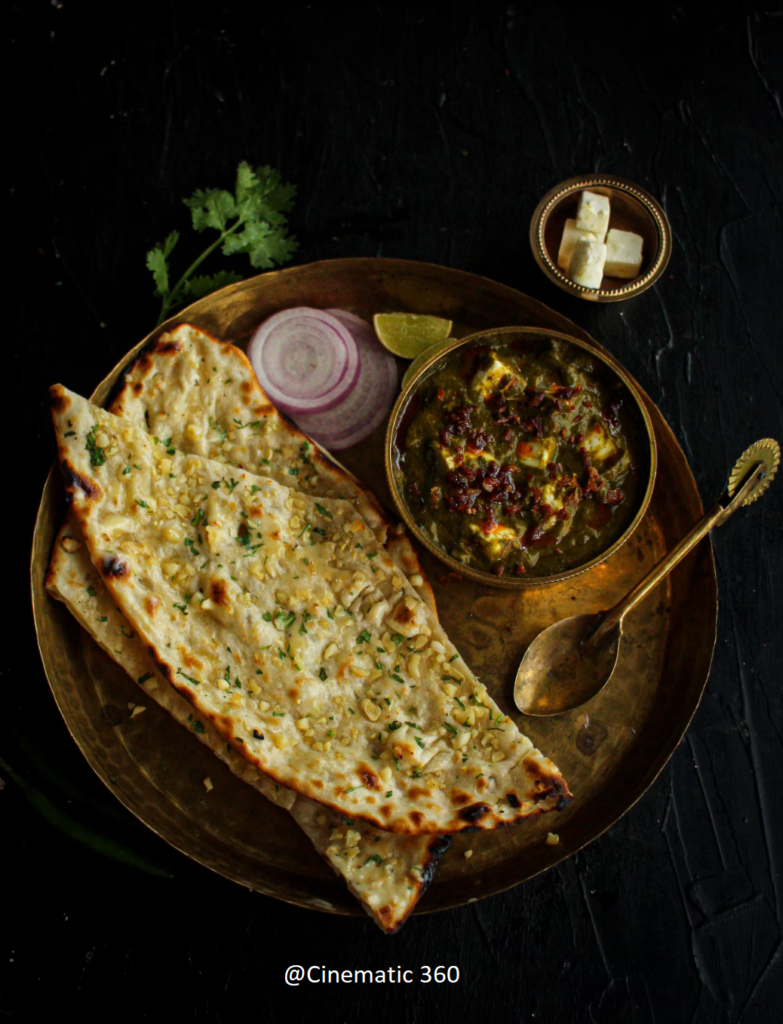
Creamy Palak Paneer curry paired with freshly baked butter garlic naan, red onions, and lime on a traditional brass plate—captured in a rustic commercial style by Cinematic360.
Pointing a camera at a plate isn’t food photography. That’s documentation. Real food photography is closer to set design. Lighting, composition, and sensory storytelling all working together to make a static dish feel alive.
1. Directional Lighting & Textural Highlights
Lighting decides whether a dish looks appetizing or clinical.
Backlighting is what makes steam rise visibly off a bowl of ramen. Without it, that steam is invisible to camera.
Side-lighting is what carves out the crust on a loaf of bread, catches the moisture on a seared steak, or stretches a cheese pull into a single, satisfying strand. Get the direction wrong — and even a perfectly plated dish looks lifeless on screen.
I captured this shot using a Sony FX3 with a 90mm macro lens from a top-down angle. For lighting, I used a large softbox positioned at 45° on the left and a small reflector on the opposite side to soften the shadows while keeping the food texture natural. The setup took around 20 minutes, including styling the props and balancing the composition. I avoid on-camera flash because it creates harsh reflections on metal plates and makes the food look flat. Soft directional lighting brings out the texture, color, and freshness, giving the final image a premium restaurant look.
2. Prop Styling & Color Harmony
Never is the plate shot by itself. rustic boards made of wood. cool slabs of marble. Raw ingredients were dispersed. A little flour. These are context that tells the client about the origin of the meal; they are not decorations. The frame is designed to draw attention to the meal rather than detract from it, and it is paired with purposeful color harmony, such as a lemon wedge against a burned protein or a green herb garnish against a warm curry.
I shot this rustic flat lay using a full-frame camera with a 50mm prime lens on a tripod equipped with an overhead arm. I chose a top-down 90-degree perspective to emphasize the symmetrical arrangement of the kababs around the central chutney bowl. To complement the warm, vintage brass plate, I built a rustic story using organic props like jute twine, raw cashews, and scattered mint on a dark textured background. I placed a single diffused key light at the top-left to skim soft highlights across the patties’ crisp texture without overexposing the metallic rim of the thali.
3. Capturing Implied Motion & Sensory Action
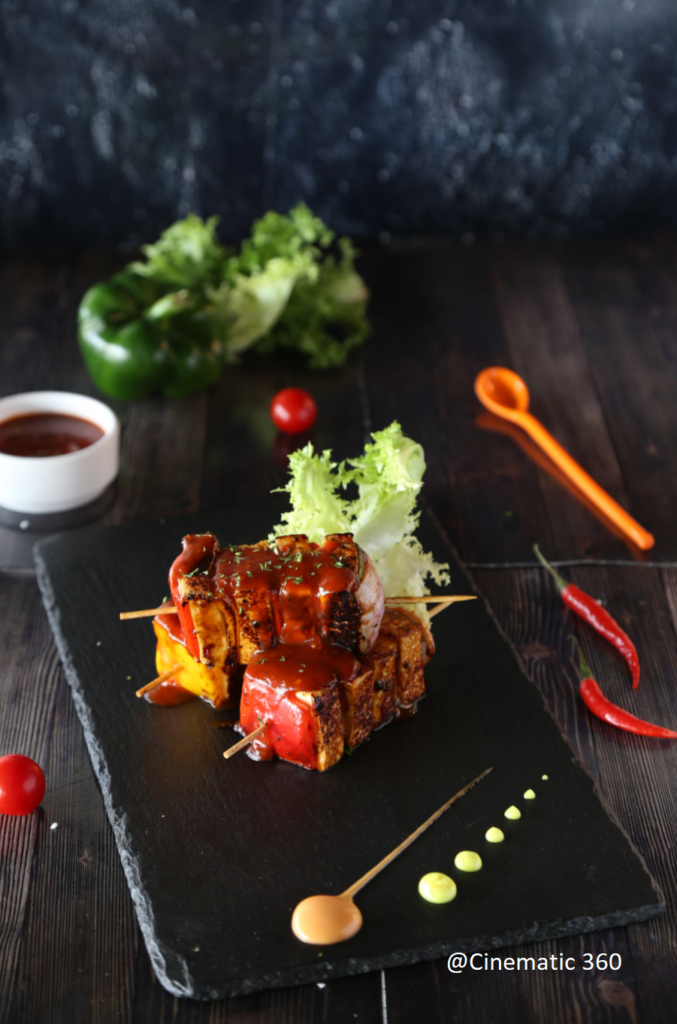
Glazed paneer tikka skewers artfully plated on a black slate slab with sauce dots and fresh greens—captured in a fine-dining commercial style by Cinematic360.
A sauce mid-pour. Powdered sugar caught mid-dust. Cheese still stretching from the slice to the pan. These action shots convert a still photo into something that feels like it’s happening right now in real time, in front of you.
It’s the difference between a photo of food and a photo that makes you taste it.
How Cinematic360 Masters Food Photography
This is exactly the gap Cinematic360 was built to close for Mumbai’s restaurants and cloud kitchens — the space between “we have a menu” and “our menu sells itself.” Our work follows the same cinematic visual principles we apply to real estate photography and commercial production because the underlying truth is the same across every category: premium visuals change what people are willing to pay.
1. Cinematic Lighting & High-Dynamic Colour Grading
Instead of using typical studio strobes, Cinematic360 uses film-grade cinema lighting equipment.
Each frame has the warmth and richness you would anticipate from a cuisine film rather than a commercial list.
Sauces, glazes, and garnishes sparkle with saturation thanks to custom color grading on each frame, avoiding the oversaturated, fake appearance that causes people to immediately suspect a picture.
For indoor restaurant shoots, I shoot with a Sony FX3 and 90mm macro lens, one 120cm softbox, and an LED cinema light at 45°. This typically takes 15-20 mins to set up, depending on the styling of the table. I don’t use on-camera flash, but instead use soft directional light to emphasize the texture, natural colors and shine of the food. This gives a premium, restaurant-quality look without harsh shadows or unwanted reflections.
2.Macro Detail & Dynamic Camera Angles
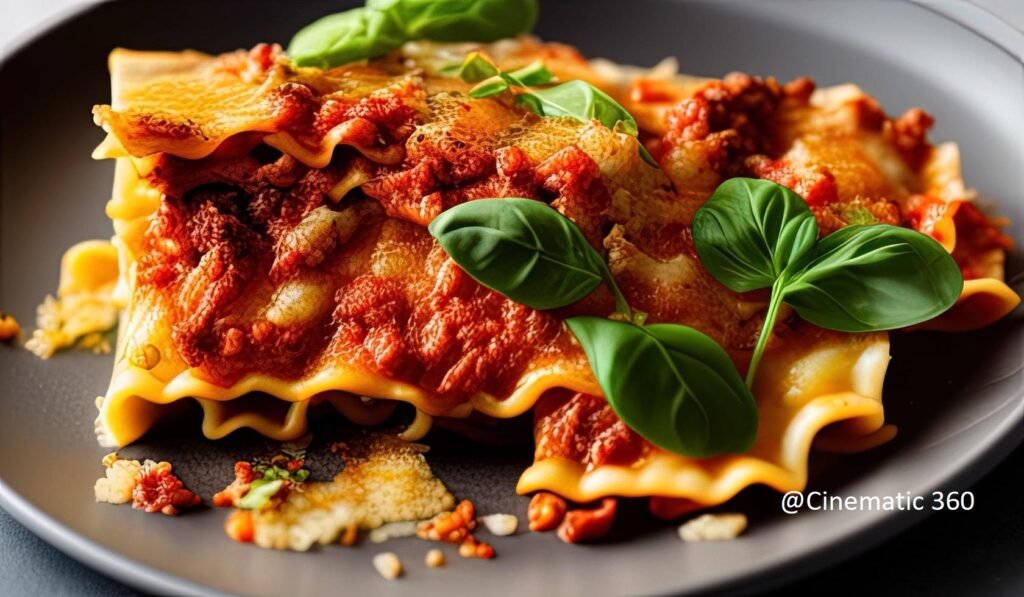
Rich, freshly baked Italian lasagna layered with savory sauce and melted cheese, garnished with fresh basil—captured in a macro commercial style by Cinematic360.
Where a phone camera blurs texture into mush, Cinematic360’s macro lens work resolves the individual crumb structure of a fried crust.
The simmer bubbles on a slow-cooked gravy. The dew on a fresh mint garnish. The sesame seeds on a brioche bun — each one individually sharp.
Combined with dynamic low and top-down angles — rather than a single flat straight-on shot — every dish gets photographed the way it’s meant to be seen. At its most flattering angle, in its sharpest possible detail.
I mostly use the Sony FE 90mm f/2.8 Macro G OSS for food photography because it brings out fine textures without distortion. I usually shoot at f/4-5.6, to keep the main subject in focus and the background a little blurred. The macro lens was used to highlight the crunchy coating, fresh herbs and creamy dip on this crispy veg cutlet platter. The dish looks much more appetizing and premium.
3. Combining Still Photography with Motion Video
These days, a menu photo by itself is insufficient. At 11 p.m., your consumer is also browsing Reels to determine where to place their order.
On-site, Cinematic360 uses a hybrid shoot methodology that combines fast-paced, cinematic 9:16 vertical video created especially for Instagram and Meta ad placements with ultra-high-resolution stills for your menu, delivery app listings, and print. One day of filming. Two full libraries of assets. There are no scheduling issues.
This is the same hybrid approach we use across our corporate video production and videography work — because brands in 2026 need static and motion assets simultaneously, not six weeks apart.
Visual Asset Packages: Built for Every Channel
Different platforms need different assets.
A hoarding shot and an Instagram Reel are not interchangeable — and treating them like they are wastes the entire shoot day.
| Channel | Asset Delivered | Business Purpose |
| Swiggy / Zomato | High-contrast isolated dish shots | Maximises menu CTR and cart additions |
| Instagram & Meta Ads | 9:16 vertical slow-mo motion Reels | Stops scrollers with steam, sizzle, and sauce |
| Website & Print Menus | Wide environmental table spread stills | Establishes brand ambiance and experience |
| Billboards & Hoardings | 100MP super-resolution master shots | Crystal-clear scale for highway ads |
For one Mumbai restaurant, I planned a full-day shoot covering food photography, chef action shots, ambience, and short cinematic reels. The shoot lasted around 6 hours, and I delivered over 80 edited photos, 5 social media reels, and a 60-second brand film. The content was used across Instagram, Facebook, Google Business Profile, Zomato, Swiggy, and the restaurant’s website, giving them a consistent visual identity across every platform.
The Business ROI: Clicks into Orders
This has nothing to do with being attractive for its own sake.
A higher click-through rate is associated with a better photo on your Zomato listing. More views translate into carts when the CTR is greater. Because consumers trust and pay for what appears premium, more carts translate into higher average order values.
The pattern is same whether you apply the same calculations to a highway hoarding, a table layout on your website, or a reel that is running as a paid meta ad. There is no marketing expense associated with every rupee spent on expert food photography. It has a direct impact on foot traffic and order volume. Restaurants who view their images as optional are losing money every time a sharper competition photo is viewed.
Want to understand how the same visual principles apply if you’re also shooting spaces — your restaurant interior or delivery kitchen setup? Our 360-degree virtual tours and Matterport 3D tours give customers a complete brand experience before they even place their first order.
Great Food Deserves Visuals That Match It
You’ve put serious effort into your kitchen. Your recipes, your sourcing, your plating — all of it.
A rushed phone photo undersells every single dish on your menu. The gap between your food quality and your visual quality is costing you orders every day — silently, invisibly, one scroll at a time.
Book a Food Photography & Video Shoot with Cinematic360 — and turn your menu into a visual magnet that gets tapped, ordered, and shared.